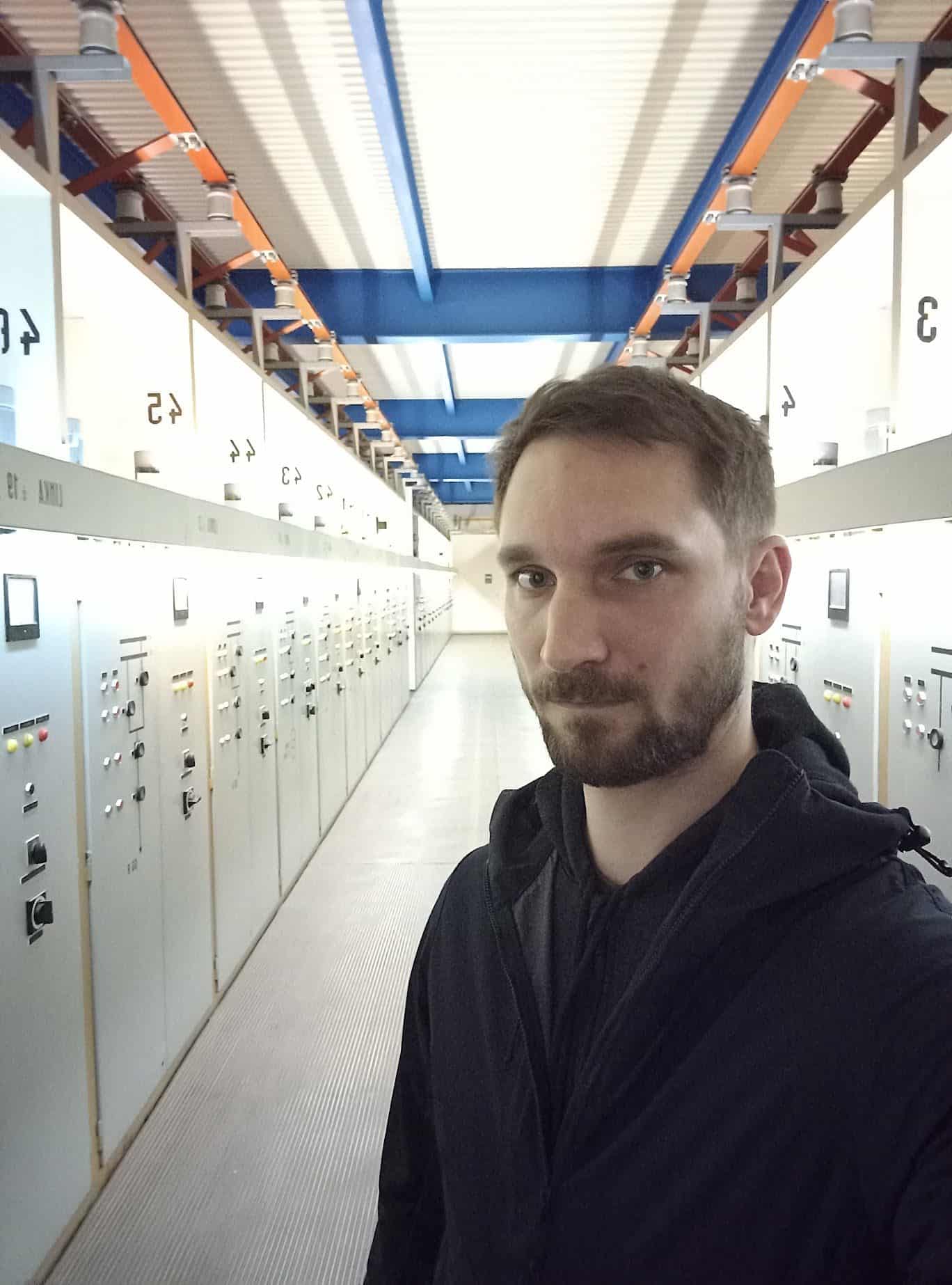

This text launches the website you are on. It presents one particular line of work: building custom websites and applications for companies that want a tool rather than a business card. Until now I did it alongside another job. From now on I do it full time.
I have no founding story, so instead here are the two things you should know about me before you write to me. I have been writing code since I was fifteen. And for fifteen years I walked around production plants as a health and safety and fire protection specialist, meaning as the person who builds systems inside companies and then watches whether anybody uses them.
That second sentence looks like a detour from web development. It is in fact the most valuable thing I bring to it, and this article is mostly about that.
I am not a career changer with a certificate
I did not start building websites last week and not after a bootcamp. I studied computer graphics and mechanical engineering at a technical secondary school, a combination that still serves me: graphics taught me that appearance has logic, engineering taught me that a thing which does not work is scrap regardless of how it looks.
Throughout that time I ran my own web projects in parallel. Not portfolio demos. Real online shops with real customers, payment gateways, invoicing and orders. Twelve years of operation, thousands of transactions, and every mistake that can be made there I have already made on my own skin and with my own money.
The difference between a developer who builds a website and a developer who then runs it for twelve years and earns a living from it is fundamental. The second one knows what breaks in year three. They know what an admin nobody dares to touch looks like. And they know what their own mistake costs, because they paid for it.
What fifteen years in bureaucracy taught me
I have to be specific here, because this is the part of my experience you cannot buy anywhere else.
In health and safety I spent fifteen years building systems nobody used. I wrote a policy. Nobody read it. The manager signed it because he had to. A month later I came for an inspection and found the same faults as before: a blocked fire extinguisher, a pallet in the walkway, a missing label on a rack. The reports looked identical every month, because nothing had changed.
I have sat through an inspection where the inspector studied documentation for six hours and then walked the shop floor in half an hour. I have been told off because the fire regulations did not list the fire stopping penetrations, a piece of information nobody will ever use during a fire, and yet it is fineable.
I do not want to spend this article complaining about the industry. I want to name a systemic fault, because it is exactly the same fault I then see on nine out of ten company websites.
There is a document that satisfies a formal requirement and serves no function. A policy for the sake of a stamp. A website so the company has a website
A website like a policy in a drawer: it exists, it was approved, it got ticked off in a meeting. Nobody buys anything through it and nobody learns anything from it, because it was not built to be used but to be complied with.
A website as a tool: it is clear who it serves and what that person should do. If people do not use it, that is the fault of the tool rather than the people, and it can be fixed.
For fifteen years I asked one question in every company: what is this for, who will actually use it, and what happens if nobody ever opens it. I had to ask, because my name was on a document that would end up with the labour inspectorate if somebody got hurt.
That is the experience I bring. Not that I know Next.js. That I can ask whether the thing you are ordering will solve your problem at all.
Why I stopped walking around shop floors
I have not left health and safety. I have left one particular form of it.
I do not want to be the person who walks the plant once a month, photographs a blocked fire extinguisher and writes a report nobody reads. That work has no outcome, and after fifteen years I see it clearly: nobody has time for safety, nobody wants to pay for it, and nobody learns from repeated faults.
What does have an outcome is a tool. Software people use because it is easier than paper. So I pour my expertise into digital products, and at the same time I build websites and applications for companies facing the same problem in a different field.
This is not leaving the industry. It is moving from the person who walks past faults to the person who builds the system so the faults do not arise.
My strongest references are my own projects
I do build custom websites and applications for clients and I am happy to show you the case studies. But I consider something else to be the strongest evidence: what I run for myself, and what keeps running when nobody is watching.
- bezpecak.safetyfrog.cz is health and safety services plus a shop with template documentation, today over 120 documents and video guides to download. Twelve years of operation teaches things no tutorial covers: matching a payment that arrived a crown short, an invoice that has to stay valid after a VAT rate change, and a customer whose file would not download at six on a Friday.
- urazy.safetyfrog.cz is an electronic accident book under new legislation, from the first record to closing the file. Built on rules that change, where the change has to run through the whole application. It taught me a data model where a deadline is derived rather than copied, and deadline tracking where you cannot afford to get a time zone wrong.
- visitors.safetyfrog.cz is a digital visitor book with training, evacuation lists and a touch terminal at reception. A multi tenant application that has to keep working when the internet drops. It taught me that offline operation and user roles cannot be bolted on later.
- forum.safetyfrog.cz is a professional forum and community for safety specialists. Moderation, spam and permissions are daily reality there. It taught me that with user generated content the expensive part is what you can delete, not what you can add.
- bozpforum.cz is an online magazine about health and safety that I have run for years and that is still going. Years of specialist articles that turned into a source people cite. It taught me how search visibility gets built over time and why a burst campaign cannot catch up with it.
On top of that a learning platform with courses, tests and certificates, and a larger application for managing safety inside companies. All of it is live, all of it has real users, and I administer all of it myself, servers, backups and deployments included.
So when the conversation turns to whether I can connect a payment gateway, send an automated email or handle logins and roles, it is not a theoretical question. All of it is in production for me.
When you order a website from me, you are not getting a designer who learned a template. You are getting somebody who deals daily with the production operation of systems his own income depends on.
How I build websites
Speed is not an add on, it is a condition
I do not sell speed as a surcharge, because it gets decided at the start, in how the site is built. This website is rendered on the server, has not a single third party script and uses no tracking tools, so it does not even need a consent banner.
The numbers below come from measuring the production build of this site. They are not numbers from a leaflet, and you can measure them yourself.
PageSpeed Insights, this site on mobile
| Label | Value |
|---|---|
| Performance | 99 |
| Accessibility | 100 |
| Best practices | 100 |
| SEO | 100 |
My price list guarantees a score above 90 on mobile and on desktop. Google marks anything above ninety green and a visitor cannot tell 96 from 100; what deserves attention is a site below ninety.
Technology with a reason
I work with Next.js and React, with NestJS and Flutter for applications, plus PostgreSQL, Prisma, Docker and my own server infrastructure. I do not pick technology because it is new. A small brochure site does not need an architecture for thousands of users. An online shop that has to earn, on the other hand, does not belong on a platform that starts choking at a hundred items.
Content and structure, not just looks
This is where most websites fall apart. They look good and do not work, because nobody thought through what the visitor should do on which page. So I deal with structure, information hierarchy, copy, the groundwork for search engines, accessibility to WCAG and measurability. The graphics training helps with form, fifteen years in processes with logic.
Operation, not handover and goodbye
I deploy the site, run it, back it up and monitor it. I know what a night looks like when something goes down, because I have had those nights on my own projects. It means the client does not have to go looking for somebody to fix a server.
Four things that carried over from safety work into building websites
These are not soft skills. They are four concrete practices I use on every project.
| From health and safety | How I use it on a website |
|---|---|
| Before writing anything, find out who will use it and in what situation | The structure of the site comes from your operation and your customer, not from a template. Hence the questions that seem unrelated to a website |
| An inspection is the one piece of feedback that never lies | The site gets measured: how many people read to the end, how many send an enquiry, where the path stops. Without measurement every change is a guess |
| Nobody reads a policy, training works | A video guide recorded on your own site is part of the delivery, not a link to generic help |
| With any risk, ask what happens when it fails | Backups, uptime monitoring and restores are part of hosting from day one, not a service discovered after the first outage |
What this site proves about itself
A site that sells web development has one advantage: it can be judged on itself. So here is what you can see on this one without me claiming anything.
- Zero third party scripts, no Google Analytics and therefore no consent banner. I measure traffic with my own tool from which no individual can be reconstructed.
- A price list broken into items and a calculation where you click the scope together yourself. Not price on request.
- Two language versions with their own URLs, not switched text on the same address.
- Accessibility to WCAG AA: contrast, keyboard operation and a visible focus ring. Verifiable with a tool rather than a promise.
- A speed measurement on the home page itself, including a link to Google's own measurement so you can check it independently of me.
If any of that turns out not to work, tell me. A site that sells itself on speed and honest numbers cannot afford to leave something like that in place.
Who I do this for
- Manufacturers and technical companies that need a site where an engineer can verify a parameter and a buyer can find the documents. This is home ground for me, because I spent fifteen years walking around plants like that.
- Companies with a process in a spreadsheet that outgrew it long ago and should be running as an application. Here both halves help: I can ask about the process and then write the code.
- Online shops that have hit the ceiling of a rented platform.
- Sole traders and specialists who want a presentation that reads as credible and is actually good for something. A small site can be done properly too.
Who I am not a fit for
So that this is not purely a sales pitch, here is the other side. I say it at the start rather than after three meetings.
- Anyone looking for the lowest price on the market. They will not find it here and it is better to establish that immediately.
- Anyone who wants somebody to maintain or patch a site built by someone else. I cannot stand behind code I did not write.
- Anyone who wants a website mainly because a company is supposed to have one. With no work for it to do, it is the most expensive box ticked in the accounts.
What working together looks like
- 1You write to me about what you are dealing with. I do not need a bulleted brief, just the situation and what you want to achieve.
- 2We have a call and I go through your operation, your customers and your competitors. The structure of the site comes out of that, not out of a template.
- 3You get a link to a calculation where you click the scope together yourself and see the price item by item. It commits you to nothing.
- 4I build on an address you can look at any time. No big reveal at the end.
- 5After launch you get a month of small changes included, training and a video guide recorded on your own site. Hosting and monitoring can stay with me.
Frequently asked questions
Why choose a developer who spent fifteen years in health and safety?
Because for fifteen years he built systems for companies and saw which ones people used and which ended up in a drawer. Most developers do not have that experience of how processes really run. Meanwhile I have been writing code since I was fifteen and running my own online shops for twelve years, so the technical side is not a new skill.
Are you still working in health and safety?
Yes, but in digital form. I run template documentation and video guides, an electronic accident book, a digital visitor book, a professional forum and an online magazine about health and safety. Field consulting and regular workplace walkarounds I no longer do.
How long does building a website take?
A one page site two to three weeks, a company website with a page per service four to six weeks, a site with custom features six to ten weeks. You get a specific date in the quote before you order, not a vague promise.
What PageSpeed scores do your sites reach?
My price list guarantees a score above 90 on mobile and desktop. On its production build this site scores 99 for performance and 100 for accessibility, best practices and SEO. Speed is a condition, not an optional extra.
Do you build online shops and web applications too?
Yes. I have run my own shop with invoicing and a payment gateway for twelve years, and besides websites I build multi tenant applications, including ones running on a touch terminal or without a connection.
Who will work on the project?
I will. Design, copy, code, deployment and hosting. On larger projects I work with a colleague from ecommerce on marketing, but responsibility for the result stays with one person.
Do you work remotely?
Yes, routinely. I will walk your site in person where it makes sense, and the rest can be handled on a call plus a link to the work in progress. The site is built at an address you can check any time.
Who owns the code and the data?
You do. The source code, the content and the database are yours, the domain is registered in your name and there are no licence fees for running it. You can take it elsewhere whenever you like.
What to take from this
- I have been writing code since I was fifteen, running my own online shops for twelve years, and I spent fifteen years doing health and safety on shop floors.
- Health and safety taught me one thing that transfers to websites directly: a document that satisfies a formal requirement and serves no function is wasted time. That holds for a policy and for a website.
- My strongest references are the projects I run myself and live off. They are live, I administer them myself and you can find them in the links above.
- Speed, accessibility and measurability are conditions here, not surcharges. You can measure this site's scores yourself.
- I am launching this site so that building websites and applications becomes the whole job rather than the evening one.
Want a website that works
Write to me about what you have in mind. I will tell you straight whether it makes sense and what I would do differently. If the answer is that one page is enough, or that a website will not help you at all, I will say that too.
Fifteen years cured me of nodding along to things that do not work.
Send an enquiry, see the case studies or the price list.