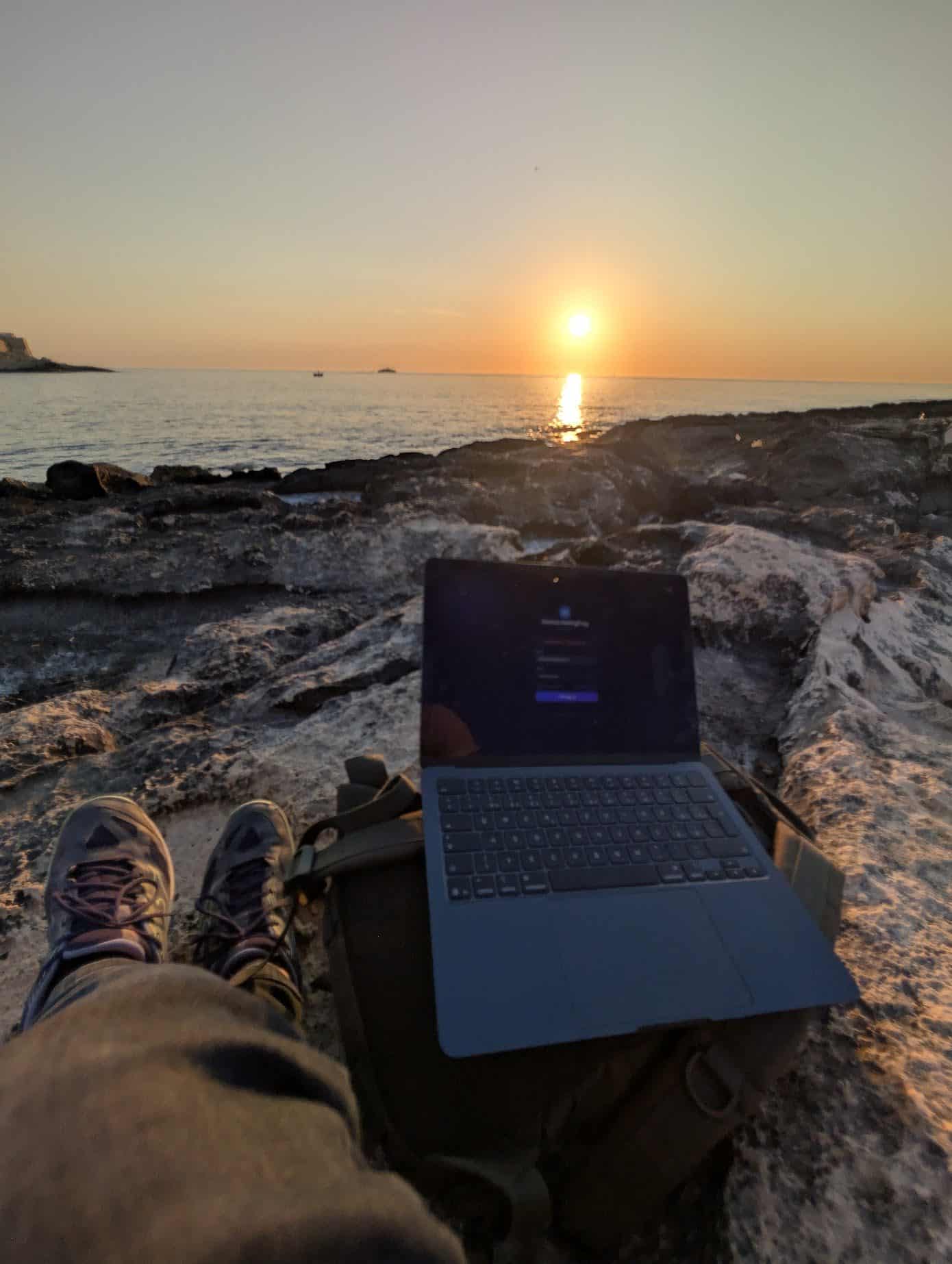

A website project runs to plan for four weeks. The design is approved, the pages are built, one thing is left: the copy the company was going to supply. Then it stops. Two weeks later an e-mail arrives: „sorry, we have not got to it yet.“ A month later the same e-mail arrives again.
It is not laziness. Writing about your own company is uncomfortable and never urgent. There is always something more pressing, and nobody notices that it went unwritten again. This single item delays more projects than every technical problem put together.
So the question is not whether to write the copy yourself. It is how to divide the work so the result is worth having and the project does not lose a month.
Short answer
- Facts belong to the company, phrasing belongs to whoever writes. Swap those and you get either a factually correct page that sells nothing, or an elegant page that says nothing about you.
- Copy written by an owner alongside their normal job is the most common reason a website runs a month over. That is not a complaint, it is arithmetic.
- The fastest way to supply material is not writing. It is twenty minutes of talking into a phone, turned into a transcript.
- A copywriter who does not know your trade will produce fluent text containing not one claim your competitor could not also make.
- Website copy is not written page by page but question by question. Anyone who does not know what the customer is asking ends up writing about themselves.
Why copy from the company is correct and lifeless
A business owner knows everything about their trade. That is exactly the problem: whatever is obvious to them goes unwritten, because it does not occur to them that anybody would not know it. And whatever interests them gets written at length, even when the customer does not care.
Typical company copy reads like this: when the company was founded, how many people it employs, how it prides itself on quality and an individual approach, which certificates it holds. All of it true, and none of it interesting, because it answers none of the customer's questions.
Customers ask other things. Can you do what I need? By when? What will it cost? Have you done this for somebody like me? What if it goes wrong? Copy that answers none of those is just a nicely written company biography.
Our company has been active on the market since 1998 and specialises in comprehensive solutions in the field of custom metalwork. We pride ourselves on quality, an individual approach and customer satisfaction.
We build steel structures and staircases to order for engineering companies. A typical job runs from 200 kg to 8 tonnes, delivered within six weeks. We weld to EN 1090 up to EXC3 and supply certification with every job.
And why copy from an outsider is empty
The other extreme fails differently and just as badly. A writer who does not know the trade is given „write us some website copy“ and writes it. It will be fluent, it will have rhythm, it will end with a call to action.
And it will contain not one claim your competitor could not also make. Because a claim has to come from somewhere. How many tonnes, by when, to which standard, with what certification. A writer cannot invent that; somebody has to tell them.
The test is simple: take the finished copy and replace your company name with a competitor's. If the sentence still holds, it is not copy about you. It is filler.
Replace your company name in the finished copy with a competitor's. If the sentence still holds, it is not about you
The division of labour that works
Neither extreme works alone. The arrangement that does is simple enough for a table.
| What | The company supplies | The writer supplies |
|---|---|---|
| Facts, figures, standards, lead times | yes | no, nowhere to get them |
| Who the typical customer is and what they face | yes | no |
| Objections you hear in meetings | yes | no |
| Page structure and order of information | no | yes |
| Phrasing, rhythm, sentence length | no | yes |
| Headlines and calls to action | no | yes |
| Checking factual accuracy | yes | no |
The last row matters more than it looks. Finished copy has to be read by somebody in the company who would catch a mistake in the trade. Not for style, but because one overstated sentence in technical copy costs you credibility with a buyer who spots it on first reading.
How to supply material in twenty minutes
This is the whole practical part of the article. It works even if you have the copy written somewhere else.
Do not write. Talk. Turn on the voice recorder on your phone and work through five questions, as if explaining them to a friend who knows nothing about your trade.
- 1Who do you sell to and what is that person dealing with when they look for you? Not the industry but the situation: a pipe burst, they need a job finished by month end, an inspection is about to lapse.
- 2What exactly do you do, in numbers? Ranges, dimensions, capacities, lead times. The more specific the better, including what you do not do.
- 3What do customers most often ask when you first talk? List five questions the way they ask them, not the way they would look in a brochure.
- 4What is the usual objection and how do you answer it? Price, lead time, distance, capacity. This is the most valuable two minutes of the whole recording.
- 5Name three jobs you are proud of and say what was hard about each. That produces references and proof at the same time.
Twenty minutes of talking is roughly ten pages of transcript, which is more material than a whole company website needs. And more to the point: you speak naturally, so it carries your words and your numbers rather than phrases you wrote because that is how these things get written.
Send the recording to whoever writes. If you are doing the copy yourself, read the transcript and simply cut. Writing from nothing is the hard part; cutting something that already exists is within anybody's reach.
What it costs to have the copy written
So we know what we are talking about. Czech copywriting rates commonly sit between 1 500 and 4 000 CZK per standard page of 1 800 characters including spaces.
A company website of twelve pages at two standard pages each comes to 24 standard pages. At the middle of that band it is around 60 000 CZK for copy alone, which is often more than half the price of the website itself.
Which is also why cheap quotes assume you will supply the copy. It is not a hidden charge; it is the single largest item in the project and somebody has to do it.
When you should write it yourself after all
There are cases where that is the right answer and there is no sense hiding them.
- When you are the only person who understands the subject. Narrow specialisms where every sentence is technical and a mistake shows. A writer will not produce it and checking takes longer than writing.
- When your voice is the product. Consulting, teaching, creative work. There the way you express yourself is part of what is being sold.
- When it is one page and the budget is small. A copywriter does not fit into that price and it is more honest to say so.
- When you enjoy writing. Not everybody puts it off. Somebody who likes writing will produce better copy than any outsider, because they know the trade.
In every one of those cases though, one thing holds: agree a deadline for the copy as firmly as the deadline for launch. Without a date it is work that gets postponed while the project waits.
How we do it
We can take the copy off your hands, and it is the thing clients most often ask for once they realise how much work it is.
- The method is the one above. We record the kick off call, follow up with questions and write the copy. You read it and correct factual errors, not style.
- Page structure comes before copy. First we decide which questions each page answers, then we write. The other order produces copy that later gets thrown away.
- We take the photos ourselves, so you are not looking for a photographer. Photos and copy happen together rather than one after the other.
- The marketing side decides what the site should claim in the first place. Without it you write elegantly but blind.
And the other side: we do have to get the facts out of you. There is no way to write good copy about a company without spending an hour with somebody from it. Anyone looking for a supplier who will write the copy entirely without them will get exactly the copy that would suit anybody else too.
Frequently asked questions
Who should write the copy for a company website?
The arrangement that works is that the company supplies facts, figures, lead times and objections, while the writer handles structure, phrasing and headlines. The finished copy then has to be checked for factual accuracy by somebody in the company. Swap those roles and you get either lifeless generalities or elegant copy that says nothing about you.
What does website copywriting cost?
On the Czech market usually 1 500 to 4 000 CZK per standard page of 1 800 characters including spaces. A twelve page company website at two standard pages each comes to 36 000 to 96 000 CZK for copy alone. That is why cheap quotes assume you will supply it.
How do I supply material quickly when I have no time to write?
Do not write, talk. Turn on your phone's voice recorder and spend twenty minutes answering five questions: who you sell to and what they are dealing with, what exactly you do in numbers, what customers most often ask, what the usual objection is, and three jobs you are proud of. Twenty minutes is roughly ten pages of transcript.
How do I know whether my website copy is bad?
Replace your company name in it with a competitor's. If the sentence still holds, it is filler rather than copy about you. Second test: look for answers to the customer's questions. Can you do what I need, by when, for how much, have you done it for somebody like me. If they are missing, it is a company biography.
Can a copywriter who does not know my industry write good copy?
They will write fluent text containing not one claim your competitor could not also make. A claim needs facts and facts cannot be invented: how many tonnes, by when, to which standard. Knowing the trade can be replaced by an hour on the phone with somebody from the company, but it has to be replaced somehow.
When does writing the copy yourself make sense?
When your field is so narrow that checking somebody else's text takes longer than writing it, when the way you express yourself is part of the product, when it is one page on a small budget, or when you simply enjoy writing. In each case, agree a firm deadline for the copy, otherwise it gets postponed while the project waits.
Summary
- Facts belong to the company, phrasing to the writer, and checking accuracy back to the company.
- Copy written by an owner alongside their normal job is the most common reason a project runs a month over.
- The fastest way to supply material is twenty minutes of talking into a phone, not writing.
- Copy that still holds after swapping your company name for a competitor's is not copy about you.
- Copywriting costs 1 500 to 4 000 CZK per standard page, often more than half the price of a company website.
- If you write it yourself, put a firm deadline on it, the same as on the launch date.
No copy, and unwilling to delay the site because of it
Get in touch. We record the kick off call, follow up with questions and write the copy for you. Your job is then to read it and fix what is factually wrong, which takes a fraction of the time writing from nothing would.